
What a ground rig costs you at desiccation
Every spring, Riverina canola growers who desiccate have to get glyphosate onto the crop in a window that opens when the greenest parts of the paddock hit 50–60% seed colour change, and does not stay open long. The choice of how to apply it is usually made on availability and price: a ground rig if the paddock will carry one, a plane if it won't or if the rig is busy.
What rarely makes it into that calculation is the crop the ground rig drives over. At desiccation the crop is at its tallest, its pods are at their most brittle, and there is no time left for it to recover. Every metre of wheel track is yield that will not reach the header.
This piece puts published numbers on that loss, works it through at Riverina yields and prices, and explains where drone application fits.
The short version
Published trials put wheel-track loss from a 36 m self-propelled rig at roughly 1.5–3% of yield, and from a 24 m trailed rig at 4–5% or more.
On a 1.4 t/ha crop at $800/t, that is $25–50 a hectare driven into the ground before harvest, or $2,500–5,000 across 100 hectares.
Drone application average $25/ha ex GST. Under a trailed rig, the crop lost to wheel tracks is worth more than that fee. Under a 36 m self-propelled rig it is worth about the same, before the rig's own running costs are counted.
A drone puts nothing on the paddock and removes the compaction a 15–18 tonne rig leaves behind.
Why the desiccation pass is the expensive one
Three things make the last pass of the season the most expensive.
The crop cannot compensate. Wheel damage early in the season is partly made up by neighbouring plants. The trial work on late-season traffic is clear that this stops once pods have set: "plants could not compensate for wheel tracks made at early pod development or early seed development" [1]. Desiccation is later than either.
The damage is wider than the tyre. In the only replicated oilseed rape trial on this question, the strip of crop that was measurably affected was about twice the width of the tyre track [2]. A rig pushing through a leaning, mature canopy knocks plants either side of the wheel, and brittle pods shatter. The Canola Council of Canada's harvest guidance recommends crop dividers on ground rigs applying pre-harvest products specifically to "reduce the amount of crop loss due to trampling and shattering" [3].
Boom width is the only lever, and it is fixed. Loss scales directly with how far apart the tracks are. A 36 m self-propelled rig on 380–480 mm tyres puts roughly 2–3% of the paddock under its wheels; a 24 m trailed rig behind a tractor on 520–650 mm tyres puts 4–5% under the tractor alone, and more again if the sprayer's own wheels do not follow the tractor's line [4].
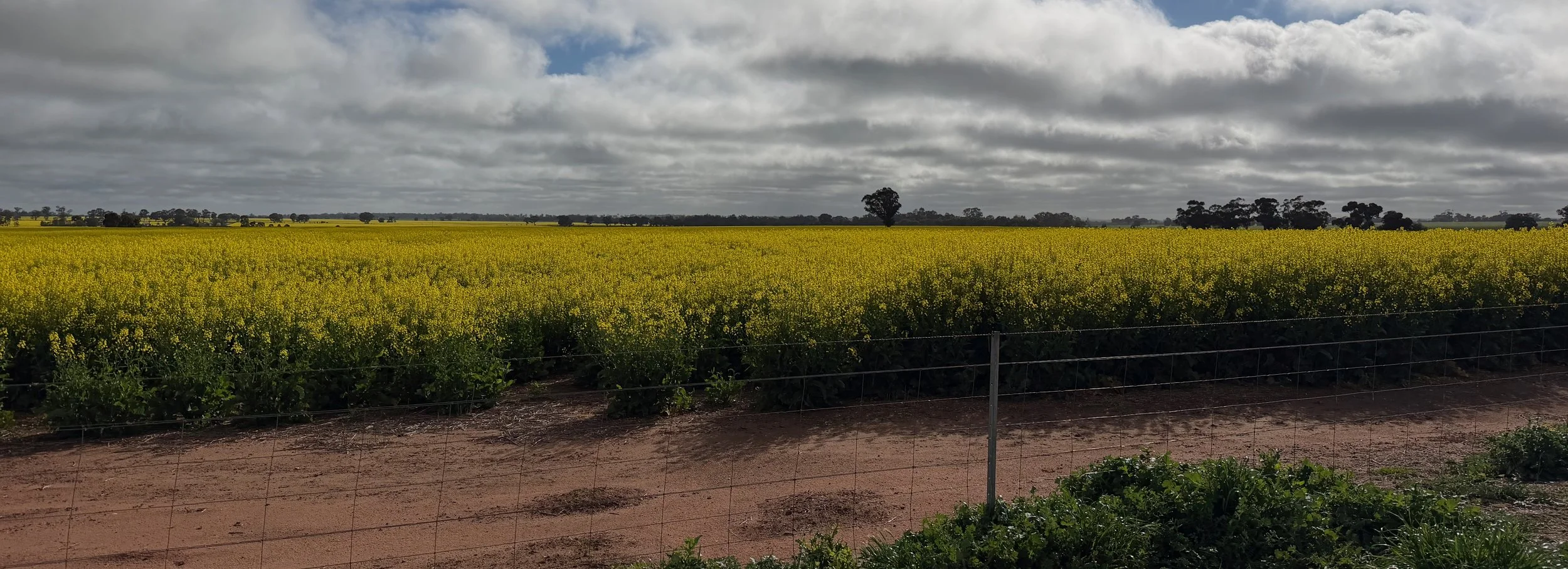
A canola crop in the Riverina
Book in early, this year is going to be unpredictable
What the trials show
There is no Australian trial that measures wheel-track loss in canola at desiccation. The figures below come from replicated trials overseas in oilseed rape and in other tall, pod-bearing crops sprayed after pod set.
| Source | Crop, rig | 36 m boom | 24–27 m boom |
|---|---|---|---|
| Sauermann 2010, Germany, 4 years [2] | Winter oilseed rape, tractor-mounted sprayer, 540–600 mm tyres | 2.7% | 4.0% (24 m) |
| Hanna et al. 2008, Agronomy Journal [1] | Soybean after pod set, self-propelled sprayer | 1.3% | 1.9% (27 m) |
| Wolf et al. 2005, AAFC Saskatoon [5] | Chickpea, self-propelled sprayer, ground vs aerial | — | 4.4% (27 m) |
| ATC Lethbridge, Alberta [6] | Wheat, trailed sprayer | Sprayer wheels off the tractor line: 1.6–1.8× the loss of wheels that follow it |
Taken together, and checked against the simple geometry of tyre width and boom width:
| Rig | Working loss range |
|---|---|
| Self-propelled, 36 m | 1.5–3% |
| Self-propelled, 24–30 m | 2–4% |
| Trailed, 24 m, sprayer wheels following the tractor | 4–5% |
| Trailed, 24 m, sprayer wheels not following | up to 7% |
What it costs on a Riverina crop
Using a dryland range of 1.2–1.6 t/ha and $750–850/t (gross $900–1,360/ha):
| Rig | Loss per hectare | Per 100 ha |
|---|---|---|
| Self-propelled, 36 m (1.5–3%) | $14–41 | $1,400–4,100 |
| Trailed, 24 m (4–5%) | $36–68 | $3,600–6,800 |
| Trailed, 24 m, wheels not following (up to 7%) | up to $95 | up to $9,500 |
That is the yield cost alone. It does not include the compaction left in the tramlines for next year's crop, the risk of bogging a loaded rig in a wet September, or the delay if the paddock will not carry one and the plane is booked out.
Two situations
Fungicide went on by air. If the flowering fungicide was applied by drone or plane, there are no late-season tramlines in the crop. A ground-rig desiccation is the first heavy pass since the crop closed over, and the full loss above applies. This is the clearest case for keeping wheels out.
Fungicide went on by ground rig. The tramlines already exist and some of the loss has already been taken. The desiccation pass still adds to it: the crop is taller and more brittle than it was at flowering, and shatter in and beside the track is the main mechanism. But the incremental figure is smaller and harder to pin down. Here the argument for a drone rests as much on trafficability, compaction and timing as on yield.
-
If the flowering fungicide was applied by drone or plane, there are no late-season tramlines in the crop. A ground-rig desiccation is the first heavy pass since the crop closed over, and the full loss above applies. This is the clearest case for keeping wheels out.
-
The tramlines already exist and some of the loss h as already been taken. The desiccation pass still adds to it: the crop is taller and more brittle than it was at flowering, and shatter in and beside the track is the main mechanism. But the incremental figure is smaller and harder to pin down. Here the argument for a drone rests as much on traffic ability, compaction and timing as on yield.
How TechShift applies a desiccant
Specifications
Platform: DJI Agras T100
Product: glyphosate, registered for pre-harvest use in canola and on-label for RPAS application
Timing: 50–60% seed colour change in the least mature areas, or seed moisture below 30%
Water rate: 30 L/ha
Swath: 10 m
Capacity: 130–150 ha/day per aircraft; two-aircraft set-up up to 300 ha/day
Mapping: paddock boundary, obstacles, waterways and buffers flown and set as exclusion zones before mixing
Price: from $25/ha ex GST; powerlines, trees and paddock shape add to it
Application runs at 3 m above the canopy with swath, droplet size and release height set for the product and conditions. Work stops when wind exceeds the threshold for the product label and the neighbours. Reloads take under a minute from a self-contained trailer carrying water, a batch mixer and a generator. One aircraft covers 130–150 ha a day; a two-aircraft set-up covers up to 300 ha.
The aircraft does not care whether the paddock is wet. It does not need tramlines. It leaves nothing behind but the chemical.
The fee against the loss
| Application cost (ex GST) | Crop lost to wheel tracks | |
|---|---|---|
| Drone (TechShift) | from $25/ha | nil |
| Plane | $15–17/ha | nil |
| Self-propelled rig, 36 m | your own running cost | $14–41/ha |
| Trailed rig, 24 m | your own running cost | $36–68/ha, up to $95 |
Before counting what a ground rig costs to run, the canola left under a trailed rig's wheels is worth more than the entire drone fee. Under a 36 m self-propelled rig it is worth about the same as the fee. Add fuel, labour, wear and an operator's time in the busiest fortnight of the year, and the ground rig is rarely the cheap option it looks like.
A plane keeps wheels out of the crop too, and on a big open paddock it does it for less: $15–17/ha against our $25. The drone earns the difference on the paddocks a plane will not take, or will not do well: powerlines, tree lines, small or awkward blocks, sensitive neighbours and houses. It also brings drift control from a few metres above the canopy, exclusion zones flown and set before any chemical is mixed, and a booking that turns up in the window. Our price starts at $25/ha for an open paddock; powerlines, trees and awkward shapes add to it.
Two limits worth knowing. We apply glyphosate, which is registered for pre-harvest use in canola and on-label for RPAS; we do not apply diquat, because its label does not permit RPAS application. And 130–150 ha a day per aircraft, or up to 300 ha with two, is less than a 36 m rig on a good day, so book against the seed-colour-change window, not the week before.
Get in touch
Direct heading canola this season and want to keep wheels out of it? TechShift operates across southern NSW, northern Victoria and the ACT.
Sources
Hanna, S.O., Conley, S.P., Shaner, G.E. & Santini, J.B. (2008). Fungicide application timing and row spacing effect on soybean canopy penetration and grain yield. Agronomy Journal 100(5): 1488–1492. Extension summary: Purdue University SPS-103-W, Managing Fungicide Applications in Soybean.
Sauermann, W. (2010). Ertragsverluste durch Fahrgassen im Winterraps. Raps 2/2010: 2–5. Landwirtschaftskammer Schleswig-Holstein. PDF.
Canola Council of Canada. Canola Encyclopedia: Harvest management: pre-harvest aids.
Lyseng, R. (2023). Protect your crop from tire tracks. The Western Producer, 9 Feb 2023.
Wolf, T.M. et al. (2005). Ground vs aerial application of fungicide in chickpeas. Agriculture and Agri-Food Canada, Saskatoon. Summary at Sprayers 101.
Agricultural Technology Centre, Lethbridge (Storozynsky, B.). Reported in The cost of trampling your crop, Top Crop Manager, 19 Nov 2007.